
Continuous deployment for documentation
This page explains the process of continuously deploying documentation in Starcraft apps and libraries.
Deployment process
We publish documentation through a process that rides on top of our software development and release process.
Main branch
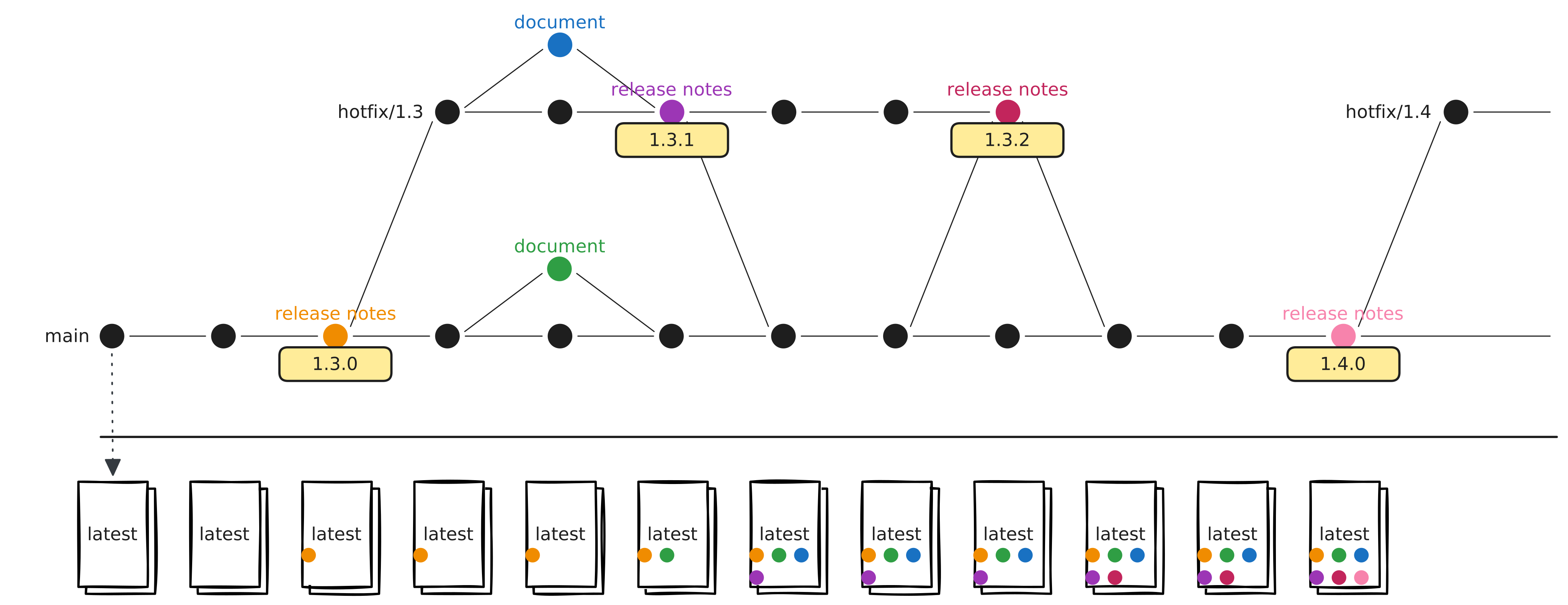
All documentation changes in the repository’s main branch are immediately deployed
to the latest documentation version on Read the Docs.
To make a documentation change for main:
A contributor proposes a document.
Both technical authors review the document.
The continuous integration (CI) system runs the documentation test suite against the document. If product code was changed, the CI system runs the full test suite.
A technical author approves and merges the document.
Read the Docs publishes the update to
https://<docs>/latest
Current releases
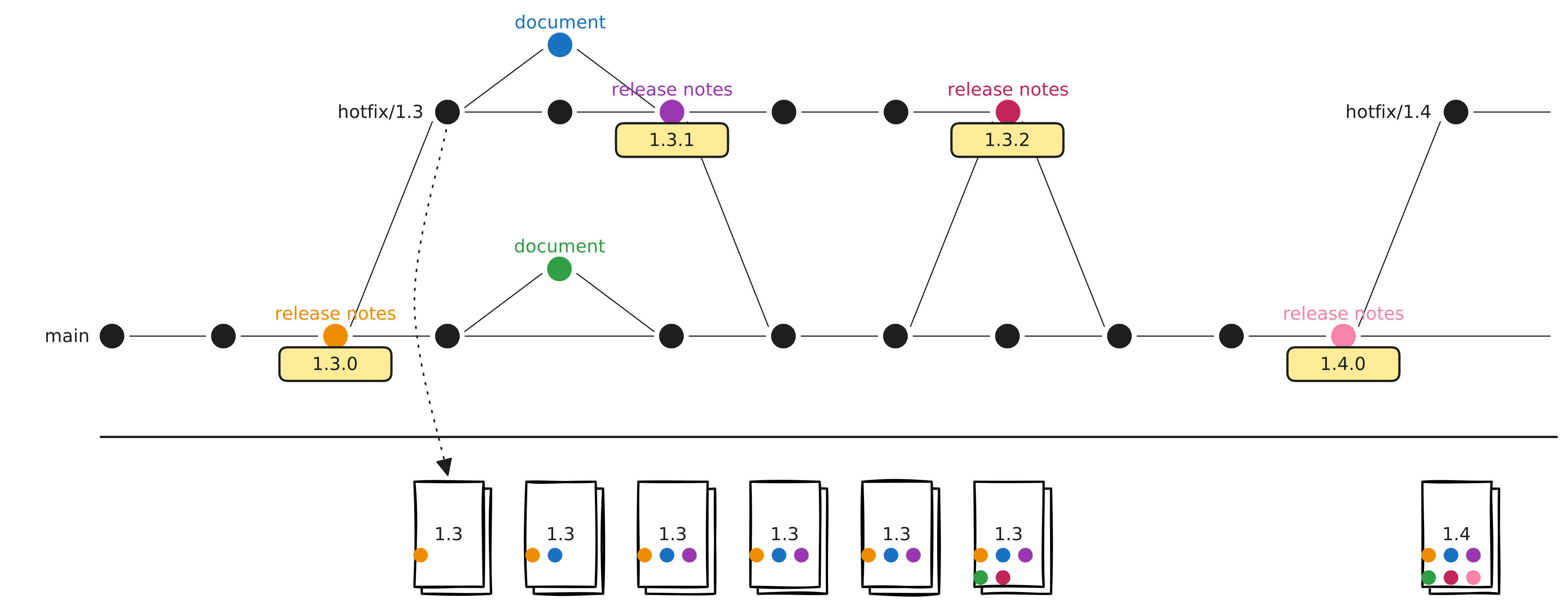
All documentation changes in a current release’s branch are immediately deployed to the
corresponding documentation version on Read the Docs. The process is largely the same as
with the main branch, with some differences in the branch controls.
Let’s take the minor version 1.3 in a product as an example. To release 1.3:
The main engineer merges any changes on the
mainbranch destined for the upcoming version.The main engineer proposes the 1.3 release notes on the
mainbranch.The CI system runs all tests against the release notes.
A technical author reviews and approves the release notes.
The main engineer merges the release notes.
The main engineer tags the commit of the release notes, signifying in the source code that the version is released.
The main engineer builds the release on the farm.
The main engineer creates the
hotfix/1.3branch.On Read the Docs, the TA creates documentation version 1.3, sourced from the
hotfix/1.3branch.The TA redirects the prior minor documentation versions to documentation version 1.3.
Read the Docs publishes the new version for that release, at
https://<docs>/1.3
To make a documentation change for 1.3:
A contributor proposes a document.
Both technical authors review the document.
The CI checks run the documentation checks against the document. If product code was changed, the CI system runs the full test suite.
A technical author approves and merges the document.
Read the Docs publishes the updated docs to
https://<docs>/1.3
Key factors
Versioned documentation is deployed from hotfix branches. The most important trait of the process is that a current release’s docs are republished with every commit. Every commit to the release’s hotfix branch republishes the documentation. They do not wait for a new release. That way, improvements to the documentation are continuous.
If documentation is deployed parallel to the software’s releases, why not merge to
main and cherry pick changes to hotfix branches instead? First, because hotfixes
and main don’t have feature parity. Documentation derived from product code, like
CLI references, can have incompatible differences. Second, the history between branches
isn’t always linear. Patches and fixes are ported forward and backward. Resolving
these differences falls to the maintainers, and we don’t want to burden them with more
work in rejoining histories.
Technical authors approve and merge. Documentation can only reach high velocity if the review process is trim. Documentation is mechanically simple, and carries much less risk than product code. Both benign and critical fixes in documents should be less costly than a change to business logic like a new feature. Neither a correction to a one-word typo nor a broken link deserve full engineering scrutiny. The technical authors provide quality assurance and are accountable for documentation, so putting maintenance burden on them doesn’t reduce quality. In complex changes, they use their judgement and ask engineers to review, if needed.
Restricted tests for documents. When a documentation change is proposed in a pull request, the CI system runs only the documentation checks. Documents are only implicated in the development test suite if they derive from the product source.
A difference in needs
By design, the documentation process differs from the development process. Each activity and the people carrying it out have different needs.
Development needs
Developers and users expect packaged software to be long-lasting and stable. Frequent and irregular releases give users the perception that the software is of low quality, and is potentially disruptive to their use. A careful approach, where software is released infrequently and at a predictable rate, is best suited for packages. That’s our thinking behind how often and when we release our software.
To develop software stably and carefully, Starcraft practices the OneFlow branching style. In it, a Git tag signifies a software release. Supported releases are further maintained inside long-lived hotfix branches, which protect concurrent releases from regression because they separate the code into different channels. Since creating a tag and spreading changes require a close understanding of the code and manual action by the developer, these are suitable controls for our packaging mindset.
Documentation needs
Each Starcraft project publishes its documentation to its own live, public website. Websites and web technologies operate on different principles than atomic packages. They are live resources available at persistent addresses, their information must be consistently accurate, and they must rarely, if ever, go offline for maintenance. This means that for a given documentation site, readers expect the documentation to reliably contain the latest and most accurate information available. It also means that fixes to the site, to the documentation, shouldn’t lag behind the software, and should never require downtime.
Deployment, not delivery
The requirements between delivering atomic software packages and up-to-date documentation are in tension with each other. Software must release as infrequently as possible, while its documentation must be updated the moment its information is out of date.
We can say, then, that our software must provide continuous delivery, where it’s capable of deployment at any time with human intervention. Documentation, instead, must practice continuous deployment, where every change to the documents must be published automatically.
Results
A good process benefits people. We want documentation deployment to be good for everyone who uses, develops, and learns our software. Here are the particular results, written as user statements, that we want it to provide.
Users
When I go to
https://<docs>/latest, I see the latest documents from themainbranch.When I go to
https://<docs>/1.3, I see the latest documents for version 1.3.If there’s a correction to the documents for version 1.3, I see it immediately in
https://<docs>/1.3.If there’s a patch to version 1.3, the patch description is available at
https://<docs>/1.3.
Contributors
When I open a PR that only changes documentation, the CI system only runs the documentation checks.
When reviewing my PR, I can expect that simple changes are merged within a day of receiving approval by the technical authors.
In product code, like the CLI strings, I can link to
https://<docs>/1.3, and not worry about the patch number.
Engineers
The process for deploying documentation is seamless and as automated as possible.
The technical authors provide the majority of the documentation review.
The technical authors can make corrections to the documentation without my oversight.